


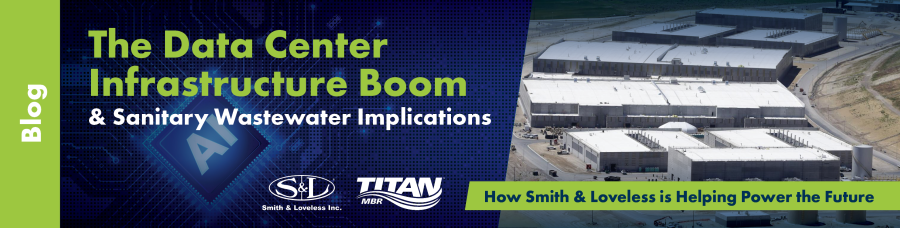
The hyper-expansion of data center development across North America is rapidly growing. Driven by an insatiable global appetite for cloud computing, continuous data architecture streaming, and the exponential rise of Artificial Intelligence (AI), hyperscale developers are deploying billions of dollars in capital infrastructure. In 2026 alone, the capital construction costs are reaching nearing $150B with projections more than doubling that total to $350B billion by 2036.
Market leaders like Amazon Web Services (AWS), Google, and Microsoft are leading this massive wave, breaking ground on sprawling campus sites in secondary and tertiary markets. However, as these multi-megawatt facilities scale, they hit an invisible roadblock that power alone cannot solve: the water-energy nexus.
What is a Data Center?
At its core, a data center is a centralized network of computing servers, data storage systems, and networking components housed within a specialized facility. These digital warehouses process, store, and distribute the applications and data that power modern life—from remote work platforms and streaming services to hospital electronic health records and banking transactions.
Because thousands of high-density processing units run continuously, they generate immense amounts of heat. Historically, data center water management has focused almost entirely on the cooling side—maximizing Water Usage Effectiveness (WUE) and utilizing free-air cooling methods to protect regional aquifers.
But as data center facilities grow to support massive, multi-shift workforces, a secondary, highly concentrated challenge emerges: localized sanitary wastewater management.
The Sanitary Wastewater Challenge: 5,000 to 100,000 GPD
While server halls don't produce domestic waste, the people who build, maintain, secure, and operate them do. A typical modern data center campus may support numerous temporary construction and operational personnel during build-out to dozens to hundreds of permanent tech professionals at full build-out, generating sanitary wastewater streams—typically ranging anywhere from 5,000 to 50,000 gpd and more, depending on the number of personnel.
Furthermore, data center sanitary waste can be uniquely challenging. Unlike municipal systems that feature broad stormwater and residential dilution, data center sanitary waste can entail slightly elevated levels of BOD/TSS and nitrogen compared to domestic sewage.
Compounding this problem, many of the best greenfield sites are located in rural or semi-rural edge-of-network locations where municipal sewer capacity is either completely absent or legally restricted from absorbing industrial-scale waste streams.
Meeting "Water-Positive" Corporate Pledges
Today’s major tech enterprises are bound by aggressive corporate sustainability frameworks, such as Amazon’s Water Positive by 2030 methodology. This means facilities cannot simply discharge poor-quality effluent or overload fragile local infrastructure. To clear stringent environmental permitting, secure social license from local communities, and meet strict internal environmental, social, and governance (ESG) metrics, developers need an advanced, on-site treatment system that guarantees pristine, near-potable effluent.
This is exactly where the Smith & Loveless packaged wastewater treatment systems bridge the gap.
The TITAN MBR™ Advantage: Engineering for Compact Clarity
For sanitary wastewater flows under 100,000 GPD, traditional concrete wastewater plants are an operational and economic nightmare. They require large physical footprints, intensive on-site civil pouring, and months of construction delays.
The S&L TITAN MBR™ solves this by condensing advanced Biological Nutrient Removal (BNR) and flat-sheet microfiltration membrane separation into a compact, factory-fabricated, pre-engineered steel package.
- Sub-Micron Physical Barrier: The TITAN MBR™ utilizes submerged flat-sheet membranes with a nominal pore size of just 0.08 microns. This creates a literal, absolute physical barrier that filters out suspended solids, eliminating the need for large secondary clarifiers.
- Pristine Effluent Quality: The system routinely drives contaminants down to ultra-low levels: BOD ≤ 10 mg/L, TSS ≤ 10 mg/L, and Ammonia-Nitrogen ≤ 0.6 mg/L. This highly polished, non-turbid water is immediately ready for advanced UV disinfection, direct environmental discharge, or looping directly into graywater recycling systems for landscaping and facility reuse.
- Factory-Built Execution: On-site construction delays can derail a multi-million-dollar data center commissioning timeline. Smith & Loveless pre-fabricates the TITAN MBR™ in a controlled factory environment. It arrives at the job site pre-piped, pre-wired, and ready for rapid installation, completely bypassing weather-related labor bottlenecks.
Integrated Infrastructure: Pumping & Headworks Integration
A world-class membrane bioreactor is only as good as the ancillary equipment protecting it. To help ensure long-term operation, Smith & Loveless can supply an integrated utility loop that manages the waste stream from influent to effluent and its clean discharge:
- Upstream Lift Stations: Raw, un-screened waste can be safely elevated into the plant using EVERLAST™ Series 1000 above-ground pump station. By keeping pumps out of the wet well, operators can inspect and maintain the equipment at ground level without entering hazardous confined spaces.
- Precision Headworks: To protect downstream membranes from fouling, hair, and fibrous debris, influent passes through an integrated OBEX™ Rotary Fine Screen. This robust physical screening step vastly extends the lifecycle of the flat-sheet membranes and can reduce Clean-In-Place (CIP) chemical cycles.
- Effluent Discharge: Following membrane extraction and UV disinfection, a second low-maintenance EVERLAST™ pump station efficiently transfers the clean water out to its final discharge point or storage reuse cell.
The Power of Single-Source Accountability
What truly sets Smith & Loveless apart in the mission-critical market is our ability to design, manufacture, and supply essentially all of the key fluid transfer and core process equipment for these sanitary treatment systems.
Instead of juggling separate contracts for influent pump stations, automated headworks, biological aeration systems, advanced membrane blocks, and effluent discharge skids, data center developers and contractors have access to a unique, single-source supplier.
This single-source execution eliminates integration headaches, ensures perfect hydraulic synchronization between the pumps and the membranes, streamlines the procurement submittal process, and provides a single point of accountability for this entire critical component of the campus's water management infrastructure.
Designing the Future of Digital Infrastructure
As North American data infrastructure continues its explosive scale-up, consulting engineers, contractors, and technology developers must treat wastewater management as a critical-path asset. Decoupling facility expansion from regional municipal limitations requires smart, compact, and automated technology.
By specifying a complete Smith & Loveless utility package—combining EVERLAST™ pumping reliability, OBEX™ fine screening, and TITAN MBR™ membrane clarity—data center projects can easily cross the finish line on time, fully compliant, and completely aligned with the highest standards of corporate water stewardship.